Home / Services / AI Training for Talent Acquisition
HRD Corp Claimable · Malaysia
AI Training for Talent Acquisitionin Malaysia
HRD Corp Claimable methodology training for talent acquisition teams in Malaysia. Not a ChatGPT or screening-tool demo. You learn how to plan and execute a hire — write a strong JD, read a good CV, choose where to post, tap free resources, interact with candidates, and manage the pipeline so people have a good experience. AI supports the desk. The method is what you take home.
2 days in-house or cohort10–20 participantsTech Talent Certificate of CompletionHRD Corp Claimable
HRD Corp Claimable. Job-linked training so employers can claim through HRD Corp (HRDC) where eligible.
Built on a live desk
Designed by Tech Talent from how we actually hire IT talent in Malaysia — not a vendor demo.
2 days, job-linked
Every exercise maps to a recruiter task you already do. Apply the same week you train.
Tech Talent Certificate of Completion
Participants leave with a shared playbook, installed templates, and a completion certificate.
What we teach in the room
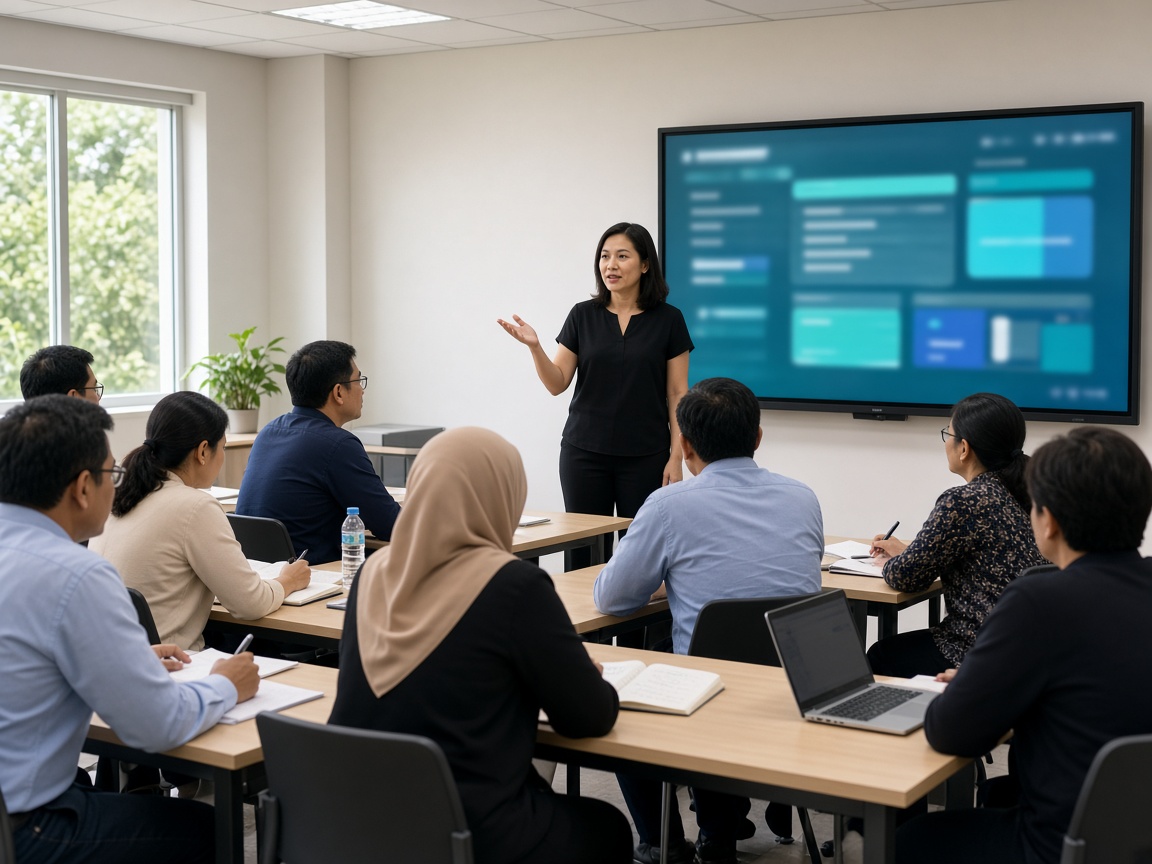
A two-day workshop for talent acquisition teams. You practise a hire from plan to close: brief, job posting, CV quality, where to post, scoring, and candidate experience. AI may draft. Your team still decides.
Tech Talent built the programme from how we hire IT talent in Malaysia. Participants leave with a shared playbook they can run the next week.
Exercises map to work you already do: strategy, brief, job posting, CV quality, channels, screen, interview, and close.
AI can draft a JD, question set, or first-pass rank. A recruiter reviews it before a candidate or hiring manager sees it.
You practise questioning the hiring manager first — STAR and must/want probes — so you do not source from a vague JD.
The team leaves with one playbook: templates, scorecards, and channels. New joiners use the same pack.
We cover what must not go into a public model: NRIC, medical detail, client files, and raw candidate dumps.
From plan to candidate experience
Seven stages. The recruiter owns the call. AI may draft.
01
Strategy
Plan the hire
02
Brief
Question the client
03
Job posting
Attract the right people
04
Channels
Post and source
05
Score & triage
Rank the pile
06
Interact
Talk to candidates
07
Close
Experience & offer
01 · Strategy
Plan the hire before you post or source
AI supports
AI helps you turn a request into a hiring plan — timeline, channels, must-haves, and what “good” looks like in 90 days.
Recruiter owns
You decide the strategy: permanent vs contract, budget, stakeholder map, and how the team will execute week to week.
02 · Intake & brief
Turn a messy brief into a clear hiring brief
AI supports
AI drafts a structured client intake — STAR-style probes, success criteria, must-haves vs nice-to-haves, and a one-page role brief your hiring manager can approve.
Recruiter owns
You run the questioning with the client. You own stakeholder alignment, budget reality, and what “good” looks like for this team.
03 · Job posting, JD & CV quality
Write a professional job posting that attracts the right people
AI supports
AI drafts scannable, professional job-post copy, flags inflated requirements and bias, and helps you compare a CV to the brief.
Recruiter owns
You decide seniority, stack truth, and employer brand. A posting that oversells or invents perks is a recruiter problem — not an AI problem.
04 · Where to post & free resources
Choose channels and tap free sourcing resources
AI supports
AI suggests job-board and LinkedIn angles, Boolean strings, and first-touch messages so outreach stays specific.
Recruiter owns
You choose where to post the role, which free resources to tap, and when a paid channel is worth it. Channel choice stays with the recruiter.
05 · Score, rank & triage
Score, rank, and triage candidates before you shortlist
AI supports
AI can draft a scoring rubric and a first-pass rank so you triage must-review, maybe, and no-fit against the same criteria.
Recruiter owns
You set the triage rules, override the rank, and decide who moves. Scores are inputs — not auto-rejects.
06 · Interact with candidates
Talk to candidates so the process feels human
AI supports
AI drafts STAR questions, outreach, interview kits, and follow-ups. It can support interview or audio assessments — first-pass only.
Recruiter owns
You run the conversation, probe, and decide. Every message and question is reviewed before a candidate sees it.
07 · Candidate experience & close
Manage the pipeline and leave people with a good experience
AI supports
AI drafts status updates, rejection notes, and offer-support talking points from your pipeline facts.
Recruiter owns
You own candidate care, timing, negotiation, and how you close or decline. A slow or silent process is a recruiter problem — not a tool problem.
What your team will build
By the end of the 2 days programme, participants leave with working assets — not slideware.
A hiring plan for a live role
By Day 1 you will have a written plan for a real (anonymised) role — strategy, brief, JD notes, where to post, and which free resources to tap.
JD, CV, and channel checklist
What a good JD and CV look like for that role, plus a posting and free-resource list your team can reuse.
Candidate-experience playbook
How you will contact, update, reject, and close — so the pipeline stays human after the workshop.
Tech Talent Certificate of Completion
Each participant receives a Tech Talent Certificate of Completion for the 2-day AI Training for Talent Acquisition programme.
Included with training — copied into your shared drive or ATS notes during the session. Not a software licence.
Client intake questioning pack (STAR)
Structured probes for hiring-manager intake — STAR, critical-incident, and must/want questions — so the brief is evidence-based, not a copied JD.
Hiring & screening prompt pack
Reusable prompt patterns for JD writing, CV screening against a rubric, outreach, and interview kits — with constraints and output format so the model does not invent a method.
Role brief & JD prompt pack
Intake questions, must/want matrices, and JD rewrite prompts tuned for IT and digital roles in Malaysia.
Where to post & free resources kit
Job-board and LinkedIn posting checklist, free sourcing resources in Malaysia, plus Boolean patterns by stack.
Job posting copy pack
Headlines, openings, and must-have blocks for an appealing, professional posting — ready to adapt for JobStreet, LinkedIn, and career pages.
Score, rank & triage sheet
A written rubric plus proceed / hold / decline triage so every recruiter ranks the same pile the same way.
Screening scorecards
Rubric templates you can load into docs for consistent scoring before shortlist.
Outreach & follow-up sequences
First-touch, bump, and passive-candidate messages that stay specific — not mass-blast templates.
Interview & debrief kit
STAR and competency questions, panel scorecards, and debrief summary prompts so panels compare fairly.
AI question bank (human-reviewed)
Generate a role question bank from the brief and rubric — then a recruiter or hiring manager reviews, edits, and approves before any candidate sees it.
Interview & audio assessment checklist
When to use live interviews vs async audio/video assessments, what AI may score, and what must stay a human review before shortlist.
Candidate experience & pipeline drafts
Keep-warm notes, rejection notes, status updates, and close talking points so candidates are not left in silence.
Programme modules
Job-linked modules so teams can apply the same week — and so employers have a clearer HRD Corp claim narrative where eligible.
01
Hiring methodology and strategy
How to plan a hire and execute it — not how to open ChatGPT. Map the full desk: strategy, brief, JD, CV quality, channels, screening, candidate contact, and close. Define where AI drafts and where humans decide.
How to plan the hire: timeline, budget, and what “good” looks like
Where time leaks today (admin vs judgement vs candidate silence)
How to measure the desk: time-to-shortlist, rewrite cycles, candidate experience
02
Structured questioning with clients and candidates
A questioning methodology you can run with hiring managers and interview panels. Use STAR, critical-incident, and must/want probes so a vague request becomes a brief — then use the same structure with candidates.
Client intake: STAR and critical-incident questions that surface real must-haves
How AI drafts the question set — and why the recruiter still runs the conversation
Candidate interviews: STAR probes, follow-ups, and scorecards that match the brief
03
JDs, CV quality, where to post, and free resources
Write a JD that attracts, know what a good CV looks like for the role, choose where to post, and tap free sourcing resources before you spend on paid channels.
What makes a JD convert — and what a strong CV actually shows
Where to post in Malaysia (job boards, LinkedIn, communities) and when
Free resources to tap before you buy more tools or ads
04
Write an appealing, professional job posting
A posting is not a dumped JD. Learn how to write copy that is professional, specific, and attractive to the candidates you want — without overselling or inflating the role.
Headline, opening, and must-haves that scan on JobStreet and LinkedIn
Tone that sounds like the employer, not a generic ad
What to cut: bias, laundry-list requirements, and vague “dynamic team” filler
05
Score, rank, and triage candidates
Stop screening on vibe. Build a written rubric, score each CV against it, rank the pile, and triage who to call first — so every recruiter applies the same bar.
Must / want / deal-breaker criteria from the brief
How to score and rank so “maybe” does not clog the pipeline
Triage rules: proceed, hold, or decline — humans still own the call
06
Candidate interaction, experience, and pipeline
How you talk to candidates, keep them informed, and manage the pipeline so people have a good experience — whether you hire them or not.
First contact, follow-up, and how to reject without burning the market
Pipeline hygiene: who owns updates, and how long silence is too long
Close and offer support without losing the human conversation
07
How to write a good prompt for hiring and screening
A vague prompt produces a vague shortlist. We teach a prompt pattern you can reuse for JDs, CV screening, outreach, and interview kits — so AI supports the method instead of inventing one.
The recruiter prompt formula: role, context, task, constraints, and output format
Screening prompts that score against your written rubric — not “is this a good CV?”
What never goes in a prompt: full NRIC, medical detail, or a raw candidate dump
How to review, edit, and reject AI output before it reaches a hiring manager
08
Supporting tools — AI, assessments, and question banks
AI and assessment tools support the method. They do not replace it. Draft JDs, question banks, and notes with AI; review every output before a candidate or hiring manager sees it.
Custom GPTs for briefs, outreach, and notes — optional, not the course
Question banks and interview/audio assessments with a human review gate
Structured screening as one input — humans still own the shortlist
09
Tools, templates, and desk playbooks
Walk the free pack end to end: hiring-plan checklist, JD and CV guides, posting and free-resource list, outreach, scorecards, and candidate-experience notes.
Install the pack into shared drives / ATS notes
Customise by role family (eng, data, infra, product)
Hand-off checklist for managers and new recruiters
10
Quality, bias, hallucinations, and PDPA
Treat GenAI like a junior assistant that can invent facts. Cover bias in JD and screening language, hallucination checks, and PDPA-aware habits when candidate or client data is involved.
Learning outcomes you can take back to the desk the same week.
Plan and execute a hiring strategy — brief, timeline, channels, and what “good” looks like
Write an appealing, professional job posting that attracts the right candidates
Recognise what a good CV looks like for the role
Score, rank, and triage candidates against a written rubric — proceed, hold, or decline
Choose where to post the role and which free sourcing resources to tap before they spend
Use a structured questioning approach with clients and candidates (STAR and related probes)
Interact with candidates from first contact through interview, close, or reject
Manage the pipeline so candidates have a good experience, even when they are not hired
Write a good prompt to support hiring and screening — role, context, task, constraints, and output format
Use AI and templates as supporting tools — with humans still owning the shortlist and the message
Apply PDPA-aware habits: what not to paste into public AI tools
Who it is for
Fits this desk
In-house talent acquisition and recruitment teams hiring IT and digital talent
Agency recruiters and account managers who need consistent desk output
RPO delivery teams rolling out shared AI habits across seats
HR and TA leaders who want claimable, job-linked AI upskilling for Malaysia teams
L&D and HR directors who need a job-linked programme they can take to e-TRiS — not a one-day awareness session
Not a fit
Teams looking for a one-hour AI awareness session or vendor product demo — this is a 2-day working programme
Individual learners wanting self-paced online content — delivery is live and cohort-based
HR generalists whose primary role is not hiring — exercises are built around recruitment and TA workflows
Teams that only want a vendor demo of one screening or chatbot product — this is a 2-day methodology programme
Delivery & HRD Corp
Format
2-day in-house workshop for your TA or agency team. Public cohort dates scheduled periodically — contact us for upcoming open dates. Minimum 10, maximum 20 participants per cohort.
Hands-on
Bring real (anonymised) role briefs where possible. You leave with configured bot patterns and a shared template pack — not slideware only.
HRD Corp Claimable
Designed as job-linked productivity training so employers can claim through HRD Corp (HRDC) where eligible. We help you align delivery with a registered provider and e-TRiS timing.
Pricing
Contact us for group pricing based on team size and whether you need a registered HRD Corp provider to facilitate the claim. Public cohort pricing is shared when open dates are scheduled.
Taught by Tech Talent's live IT recruitment desk in Malaysia — the same team that plans hires and talks to candidates.
What participants say
“Very valuable training on how to use AI and bots to screen CVs and how to write a better JD.”
Azura binti Ismail
Telekom Malaysia
“I learned a lot. The questioning methodology was useful and the AI usage was great. The trainer gave us many bots to help us screen CVs quickly.”
Suraini Mohammed
Talent Manager, Bank Muamalat
“I learned why the JD is important, how to use it effectively, and how to attract candidates. Now I can source people 3× faster and be more productive.”
Tan Kah Hou
Talent Executive, Alliance Bank
FAQs
Is this just ChatGPT or an OPAL product course?
No. This is a hiring methodology programme: how to plan and execute a hire, write an appealing professional job posting, know what a good CV looks like, score, rank and triage candidates, choose where to post, tap free resources, interact with candidates, and manage the pipeline so people have a good experience. AI and screening tools support the method. They are not the course.
Do you teach how to write a job posting that attracts candidates?
Yes. A posting is not a dumped JD. We teach how to write appealing, professional copy — headline, opening, and must-haves that scan on JobStreet and LinkedIn — without overselling, bias, or a laundry list of requirements.
Do you teach how to score, rank, and triage candidates?
Yes. Participants build a written rubric from the brief (must / want / deal-breaker), score CVs against it, rank the pile, and triage proceed / hold / decline. AI can draft a first-pass rank. Recruiters still own who moves forward.
Do you teach a questioning approach with clients, such as STAR?
Yes. A core module is structured questioning with hiring managers and candidates. For clients, we use STAR, critical-incident, and must/want probes so a vague request becomes an evidence-based brief. For interviews, the same structure produces STAR questions and scorecards that match that brief. AI drafts the question set; the recruiter still runs the conversation.
Do you teach how to write a good prompt for hiring and screening?
Yes. A dedicated module covers how to write prompts that support hiring and screening: role, context, task, constraints, and output format. Screening prompts score a CV against your written rubric — they do not ask “is this a good candidate?” You review every output before it reaches a hiring manager, and we cover what must never go into a public model.
Do you cover interview tools, audio assessments, and AI question banks?
Yes. We cover supporting tools beyond ChatGPT — including interview and audio/video assessments, and AI-generated question banks built from the role brief and rubric. AI drafts the questions and can transcribe or first-pass score an assessment. A recruiter or hiring manager reviews, edits, and approves every question and score before it affects a candidate. Tools support the process; they do not auto-hire.
Is this HRDC / HRD Corp claimable?
It is designed as job-linked AI productivity training for recruiters so employers can pursue an HRD Corp claim where eligible — typically via a registered training provider, approved course, and grant approval on e-TRiS before training starts. Eligibility depends on the employer’s levy status, participant profile, and the final approved programme. We confirm claimability with you during booking.
What are the Custom ChatGPT bots?
Practical Custom GPTs configured for recruitment tasks — for example a JD assistant, sourcing Boolean helper, interview-kit builder, or client-update drafter. We show how to set instructions, upload safe reference material, and keep humans in control of final shortlists and offers.
What free AI tools and templates do we get?
Included with the programme: a client intake questioning pack (STAR and must/want probes); an AI question-bank template with a human review gate; an interview and audio assessment checklist; prompt packs for JD drafting, Boolean/sourcing, and client updates; screening scorecards; and outreach templates. They are practical desk assets — not a separate software licence.
Do we need ChatGPT Team / Enterprise to attend?
No. A ChatGPT account is useful if you want the optional bot exercises. The core programme is the hiring method — strategy, JDs, channels, and candidate experience. We can adapt tool examples to whatever your team already uses.
Will AI replace our recruiters?
No. The operating model is draft with AI, decide with humans. Custom bots and structured screening accelerate admin and consistency. Shortlist decisions, culture fit, stakeholder management, and offer calls stay with recruiters and hiring managers.
Can you tailor this to IT recruitment only?
Yes. Tech Talent delivers IT and digital hiring day to day in Malaysia, so examples, Boolean kits, and screening rubrics lean into engineering, data, cloud, cybersecurity, and product roles. We can also adapt language for generalist TA teams that hire across functions.
How long is the programme?
2 days, delivered as an in-house workshop for your team or as a public cohort session. Day 1 covers hiring strategy, briefs, JDs, CV quality, where to post, and free resources. Day 2 covers candidate interaction, experience, supporting tools, templates, and PDPA — every participant leaves with a playbook they can run the next week.
How many people can attend?
10 to 20 participants per cohort — enough for a real team session with hands-on exercises, small enough for personalised feedback on your role briefs and bot configurations. For larger teams, contact us about running a second cohort.
Do participants receive a certificate?
Yes. Each participant receives a Tech Talent Certificate of Completion for the 2-day AI Training for Talent Acquisition programme.
How much does it cost?
Contact us for group pricing based on team size and whether you need a registered HRD Corp provider to facilitate the claim. Public cohort pricing is shared when open dates are scheduled.
HRD Corp claims depend on current scheme rules, registered providers, grant approval timing, and participant eligibility. See hrdcorp.gov.my. Tech Talent will confirm the delivery model and claim path before you book.
Ready to modernise how your team uses AI to hire?
Tell us headcount, in-house vs public format, and we will propose dates, the module outline, and the HRD Corp Claimable path for your team.